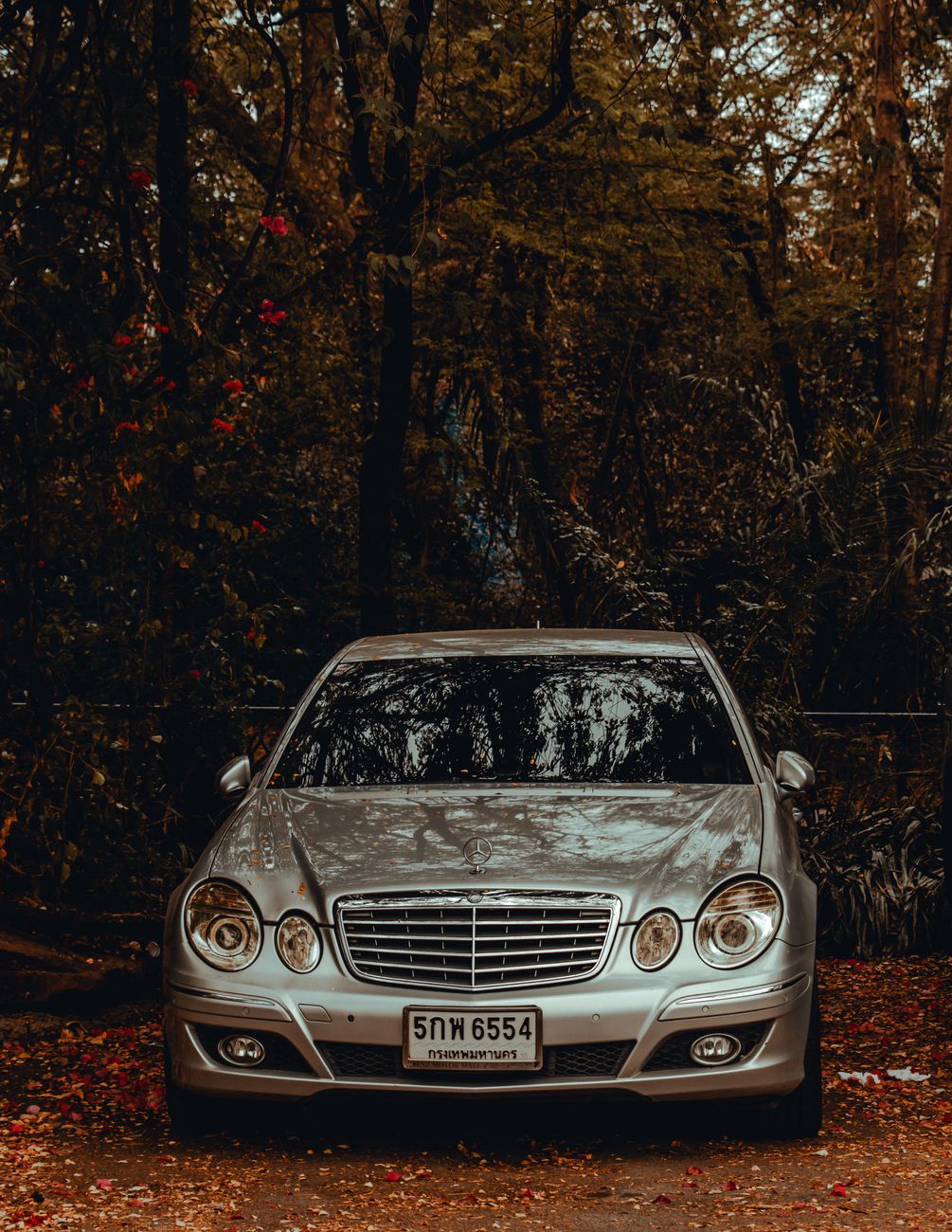
We are gathered here today, in spirit if not in an actual car park, to say goodbye to a machine that should never have existed, was built anyway, and was better for it. The Mercedes-Benz E55 AMG. A supercharged V8 dropped into a sedan your accountant would drive, sold to actual families, in actual dealerships, with actual warranties. It should have been a footnote. Instead it became a legend, and it deserves a proper send-off.
Why They Made It
To understand why the E55 exists at all, you have to understand what it replaced. The earlier W210-generation E55, sold from 1999, was a genuinely quick executive saloon by the standards of the day — a naturally aspirated 5.4-litre V8 making 349 horsepower, which at the time was a properly big number for a four-door family car. But AMG, by the early 2000s, had a problem. Everyone else was catching up. The BMW M5 was coming for it. Audi’s RS6 was coming for it. And a naturally aspirated V8, however charming, was starting to look like bringing a very nice knife to a gunfight.
So AMG did what AMG has always done best when cornered: it panicked in the most magnificent way possible. Rather than simply chase more displacement, or more revs, engineers bolted a Lysholm-type supercharger onto the 5.4-litre V8 and, in doing so, created the M113K — an engine that would go on to win International Performance Engine of the Year in 2003. When it launched at the Paris Motor Show in September 2002, it wasn’t just quick for a saloon. It was, at the time, the fastest production sedan in the world, full stop, no asterisk required.
How They Built It, and Why It Worked
The numbers still don’t quite make sense, more than two decades later. 469 horsepower. 516 lb-ft of torque, most of which arrived low enough in the rev range that you barely needed to ask for it — 700 Nm on tap from around 2,650 rpm, in a car that also had to carry four adults, a boot full of shopping, and a badge that said “Mercedes” rather than “please respect my life choices.” Zero to 60 in around 4.2 to 4.5 seconds depending on which magazine’s stopwatch you believed, at a time when a 444-horsepower Porsche 911 Turbo was considered a supercar and BMW hadn’t even managed 400 horsepower in an M3 yet.
Here’s the genuinely clever part, though: AMG didn’t just chase a big number and hope for the best. They tuned the whole car — a properly sorted AIRMATIC air suspension, a five-speed automatic (initially considered a compromise, quickly proven to suit the engine’s enormous low-down torque perfectly), steering-wheel-mounted gearshift buttons borrowed straight from Formula 1 thinking — around the idea that this should still, underneath all that violence, behave like a Mercedes. Comfortable when you wanted comfort. Absolutely deranged the moment you asked it to be. It wasn’t a sports saloon pretending to be sensible. It was a genuinely sensible saloon that had, for reasons never fully explained to shareholders, been possessed.
Why It Was So Loved
The E55 earned something rarer than speed: loyalty. Owners fell for that low-down, supercharged torque so completely that when AMG eventually replaced it with the naturally aspirated E63 — more peak power, but arriving later in the rev range and with noticeably less torque — there was an actual, documented backlash. People missed the E55’s specific character. Not just its speed, but the way it delivered that speed: instantly, low down, without needing to be worked for it. You didn’t rev an E55 into submission. You just thought about going fast, and it had already started.
And it turned out to be one of the most reliable AMG V8s ever built — the M113K has developed a reputation, deserved, as bulletproof by supercharged-performance-engine standards, the sort of engine that shrugs off high mileage in a way that makes plenty of newer, more complicated performance cars look faintly embarrassed.
What Were They Drinking?
So, seriously — what was Mercedes thinking? A supercharged V8 executive sedan, sold to ordinary buyers, at a time when everyone else was still arguing about whether saloons needed to be exciting at all. My honest theory: they weren’t drinking anything sensible, they were drinking whatever it is that makes an engineer look at a family car and think “yes, but what if it could also destroy a Porsche from a standing start.” Some brief, glorious window in the early 2000s where AMG had the freedom, the budget, and apparently nobody sensible enough in the room to say “are you sure,” and the result was a car that had absolutely no business existing and existed anyway, in real numbers, on real roads, doing the school run at a speed that should legally have required a license category all its own.
They don’t build them like this anymore, not because they can’t, but because nobody’s allowed to. Emissions rules, downsizing, electrification — all perfectly reasonable reasons, and none of them make the loss sting any less. The E55 AMG was a mistake in the best possible sense: the kind of mistake that only happens when a company briefly forgets to be sensible, and the world is better for the accident.
Rest in peace, you supercharged, low-slung, utterly unnecessary triumph of a sedan. We won’t see your kind again.


Leave a comment